From Asia to the Pump: How Prices Are Shaped for Greece
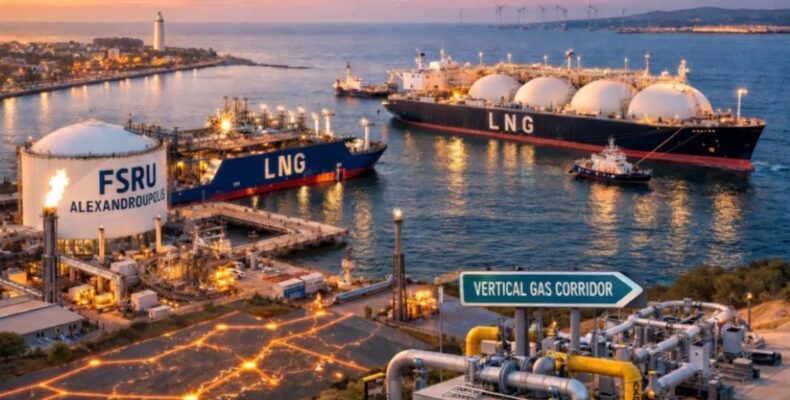
Europe is currently operating within a global energy market where Asia acts as a price-setter, a fact that radically alters the framework of supply security and pricing and forces European states to operate not as autonomous regulators but as players within a system determined beyond their borders. In this environment, Greece, as a small and open economy, lacks both the scale and the long-term contracts that would allow it to absorb the volatility of a market that is becoming increasingly tight, competitive, and expensive. As a result, security of supply is no longer a matter of pipelines or ships but a matter of access to a global pool of cargo, redistributed based on Asian demand rather than European balances. This transforms energy policy from a technical management field into a matter of geo-economic power, where a country’s position is determined by its ability to compete in a system it does not shape itself.
Greece is exposed to three vulnerabilities. International price fluctuations are driven by Asia, which absorbs available cargo and drives up the premium. During periods of high Asian demand, spot cargoes do not reach the Mediterranean, because the price is determined by Asian marginal demand rather than European needs. Prices in Greece are not set by Greek refineries, which follow international benchmarks, primarily Brent and Platts Mediterranean, benchmarks over which the country has no influence. At the same time, Revithoussa and Alexandroupoli operate without long-term contracts, with the result that the country remains subject to a pricing system it cannot influence. This limits its ability to plan a long-term strategy and traps it in a role of passive adaptation.
The situation is exacerbated by U.S. import quotas. The U.S. export margin is only fifteen to twenty percent of production, while the future consumption of one hundred billion cubic meters by hyperscale data centers further reduces the amount available for export. The U.S. cannot serve as a stable marginal supplier, and Greece cannot rely on an American safety valve to stabilize its prices.
The risk for the country does not stem from its domestic needs, which amount to just 6.5 bcm and are therefore small in absolute terms. It stems from the structure of the global market, where Asia possesses massive absorption capacity and acts as a preferred buyer, diverting shipments before they reach Europe. Thus, Europe, and Greece in particular, remain residual buyers, absorbing not the quantities they need but the quantities that are left over.
Vulnerability manifests itself primarily in prices rather than in physical supply, turning the energy issue into a top-priority political and economic problem. In this context, the country’s hydrocarbon potential—neglected for decades—could have served as a partial counterbalance to international price volatility, had it been developed in a timely manner, thereby reducing dependence on a market over which Greece has no influence. However, this issue was never seriously addressed by successive governments, which failed to incorporate it into a coherent energy strategy.
At the European level, the excise tax is undergoing a transitional restructuring. The EU’s Fit for 55 initiative promotes tax harmonization based on energy density and emissions. Electric mobility reduces fuel revenue and leads to new models, such as road charging. The energy transition is shifting taxation from fuel consumption toward vehicle use and emissions. In this context, the lower proposed European excise tax rate, which many countries have adopted in recent years, was never implemented by Greece, which maintained a higher level of fuel taxation. However, this is changing radically: as electric mobility expands, member states will need to tax electric mobility as well in order to maintain public revenue. This transition means that the current tax advantage of countries that had low excise taxes is disappearing, while Greece, which already has a high tax base, will have to adapt to a new European framework where taxation will be distributed differently, but not at lower rates.
The problem cannot be solved as long as Greece remains fully exposed to a market determined by Asia and as long as it lacks long-term contracts, domestic production, or hedging mechanisms. It will only be solved if the market structure or Greece’s position within it changes. This requires stable access to supplies through long-term contracts, increased storage capacity, and diversification of sources. It requires a common European supply mechanism that will reduce Asian influence. If none of this happens, the current situation will persist, and the country will continue to operate within a framework where the price of energy is not only an economic indicator but also a political constraint.
Defence Point / Energy Security, Saturday, May 23, 2026