Layered Anelasticities: When New Shocks Arrive Before Old Ones Heal
The global energy system increasingly behaves like a material under continuous deformation; anelasticity is the incomplete recovery after stress, while hysteresis is the persistence of that stress in shaping future reactions. The system absorbs shocks, adjusts to new pressures, and yet never fully returns to its previous state. What distinguishes the current moment in energy is the accelerating tempo of events: new disruptions arrive before the system has healed from earlier ones, creating layers of residual tension that accumulate over time. Each disturbance lands on a structure already carrying the memory of previous stress, and that memory becomes part of the system’s architecture.
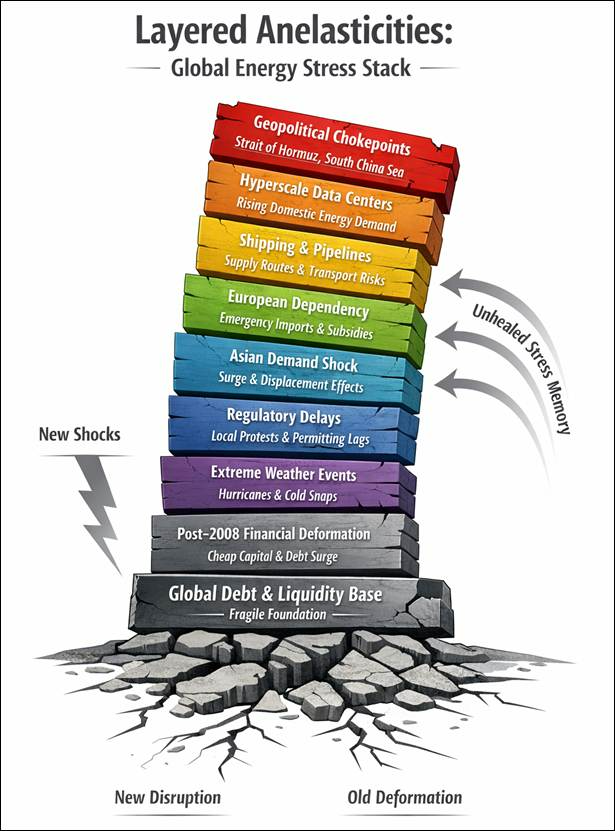
The Lego‑tower metaphor captures this dynamic. New cubes are added faster than older ones can be reinforced or removed. These cubes represent new technologies, new geopolitical rivalries, new supply routes, emergency interventions, and expanding financial obligations. They accumulate at the top of the structure while the base remains comparatively weak. That base is the global debt architecture spanning the United States, Europe, China, and emerging economies. Debt expands faster than economic capacity; the tower rises faster than its foundation can support, and the system loses its ability to heal.
The Crisis Threshold
A short disruption lasting two or three months can be absorbed. Storage can be rebuilt, supply chains can adjust, markets can reprice risk, and even geopolitical tensions can stabilize once actors recognize the cost of escalation. The global energy architecture has repeatedly shown that it can reorganize itself under pressure. The risk emerges only when a crisis pushes into a fourth month without relief. At that point, accumulated stress begins to interact with deeper structural weaknesses: storage depletion, refinery saturation, shipping congestion, liquidity tightening, and sovereign‑risk repricing converge. This is also the moment when the struggle for dominance over energy routes becomes decisive. States begin to test chokepoints, redirect flows, weaponize transit rights, and compete for control of the corridors that determine who absorbs the shock and who exports it. Once these pressures align, the tower built on a fragile global debt foundation becomes vulnerable to a sudden shift. And once it tilts, it does not straighten again.
Modern Diplomacy / Energy, Wednesday, April 15, 2026