Newsletter 15 April, 2026
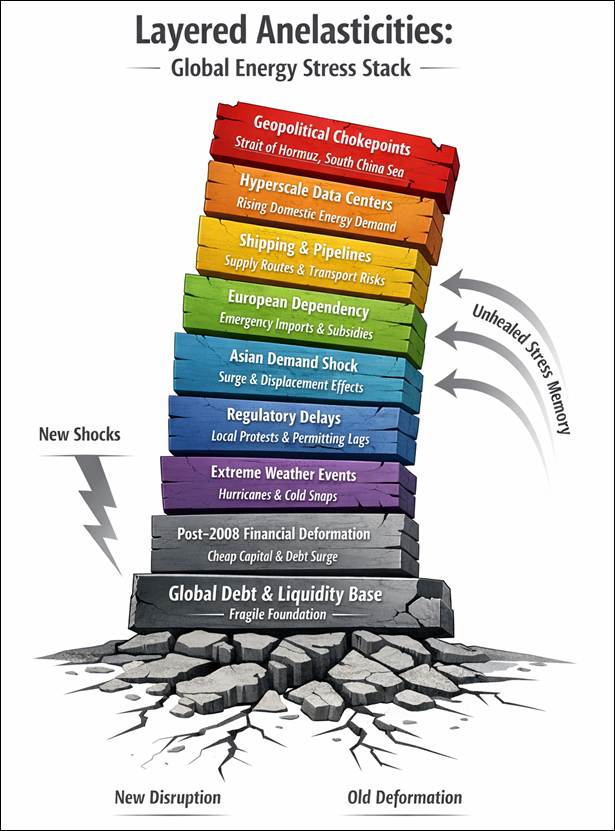
The past months have revealed a global energy system that no longer resets after each crisis. Instead, it accumulates stress. Whether described through the Lego tower metaphor, the layered anelasticities shaping global markets, or Europe’s slow awakening to geopolitical exposure, the message is consistent: shocks now arrive faster than the system can heal, and the memory of each disruption becomes part of the next one.
Across the four articles below, a single architecture emerges. The global energy system behaves like a material under continuous deformation. The 2008 financial crisis bent the foundation; the European gas crisis of 2021–2022 added a new layer of tension; the militarization of Hormuz, the industrial race in the Gulf, and the long spine vulnerabilities of US LNG add further cubes to a tower whose base is debt driven and structurally fatigued. Every new event, a drone incident, a shipping delay, a regulatory bottleneck, lands on a system already carrying the memory of previous distortions.
Europe sits at the most fragile point of this architecture. For decades it believed geopolitics had ended, treating energy as a technical commodity rather than a strategic asset. That illusion collapsed the moment the continent realized that its last remaining Russian pipeline corridor, TurkStream, had become a single point of failure. The attempted sabotage in Serbia, the hybrid pressures in the Black Sea, the Baltic infrastructure attacks, and the renewed insecurity in the Gulf form a continuous arc of exposure. Diversification has not eliminated vulnerability; it has merely shifted it from pipelines to maritime routes, from Russia to global LNG, from land chokepoints to shipping lanes.
At the same time, Europe’s dormant hydrocarbon fields, hundreds of inactive assets across the continent, stand as a reminder of how strategic complacency can turn abundance into vulnerability. The continent that once dismissed its own subsurface potential now faces a world where energy security determines industrial competitiveness, agricultural stability, and political cohesion. When the TTF shakes, Europe shakes.
The broader global picture is no less complex. The Middle East is engaged in an industrial race to dominate ammonia, hydrogen, and urea supply chains. Asia acts as the demand anchor whose procurement cycles set global prices. The United States, despite its LNG strength, faces internal constraints from long transport chains and rising domestic consumption from data centers. And beneath all of this lies the silent foundation: a global debt architecture that amplifies every shock and limits the system’s ability to recover.
These are strange times, not because crises are new, but because they no longer dissipate. They stack, they accumulate, they reshape the geometry of the system. Amphore Energy aims to map this geometry without comfort or euphemism, and with a clear effort to articulate the strategic consequences for governments, markets, and societies.
https://moderndiplomacy.eu/2026/04/10/the-continent-that-believed-geopolitics-had-ended/