Newsletter 8 July, 2026
Energy & Geopolitics Newsletter — July 2026
The initial "Green Transition" was largely an economic construct fueled by financial markets seeking a brand-new, highly regulated asset class like carbon credits and green bonds. However, this framework has now collided head-on with the hard physics of the 21st-century tech boom.
This retrospective details how the global scientific and financial apparatus aligned behind the anthropogenic (human-caused) carbon model in the late 1990s and 2000s, sidelining alternative theories. Specifically, it highlights the work of physicist Henrik Svensmark and astrophysicist Nir Shaviv (later supported by CERN’s CLOUD experiment), who proposed that solar activity and cosmic rays dictate low-level cloud cover and Earth's reflectivity. A profound systemic bias emerged: the carbon-centric model was aggressively funded and institutionalized because human emissions could be taxed, legislated, and monetized through emissions trading and green technology markets. Because a cosmic climate theory offered no such financial levers, it was marginalized. Today, however, this ideological framework is sharply receding under the pressure of immediate energy survival and military investments.
https://www.defence-point.gr/otan-ta-synnefa-skepazan-tis-klimatikes-afigiseis-michani-toy-chronoy.
The AI Resource battlefield exposes the immense physical footprint of the digital revolution. Artificial Intelligence is strictly bounded by thermodynamic laws: the massive electricity consumed by hyperscale data centers (up to 300 MW per facility) converts entirely into ambient heat. Dissipating this thermal load demands staggering volumes of water reaching up to 2 liters per kWh under operational strain. By 2030, these data clusters are projected to consume water equivalent to the basic needs of 1.3 billion people.
Because intermittent, weather-dependent technologies cannot provide the unbroken, hyper-dense baseline supply required at scale, this infrastructure boom is triggering a long-term resurgence in natural gas and nuclear power. This trend is creating acute conflicts over regional land and water rights with local agriculture. Consequently, international capital is rapidly pivoting away from purely ideological ESG targets toward resource realism. The historical cycle has broken: investment is shifting from carbon-mitigation compliance back to raw physical energy density.
https://up-magazine.info/ia-data-centers-eau-cout-cache-revolution-numerique/
Greece’s domestic energy trajectory faces updated hydrocarbon timelines, contrasting gas exploration in Crete with the Ionian Sea. The analysis explains that exploration in Crete did not fail geologically, but chronologically; paralyzed by bureaucratic delays and shifting political will, the state missed key investment windows. While the Ionian assets offer a vital second chance, success depends on abandoning past administrative sluggishness and aggressively capitalizing on natural gas as a non-negotiable fuel.
This financial reorientation directly reshapes Mediterranean exploration initiatives. Natural gas is no longer viewed by financiers as a stranded asset to be rapidly defunded, but rather as an indispensable, highly investable guarantor of sovereign digital and economic survival.
(https://www.naftemporiki.gr/opinion/2133199/i-empeiria-tis-kritis-kai-i-eykairia-toy-ionioy/)
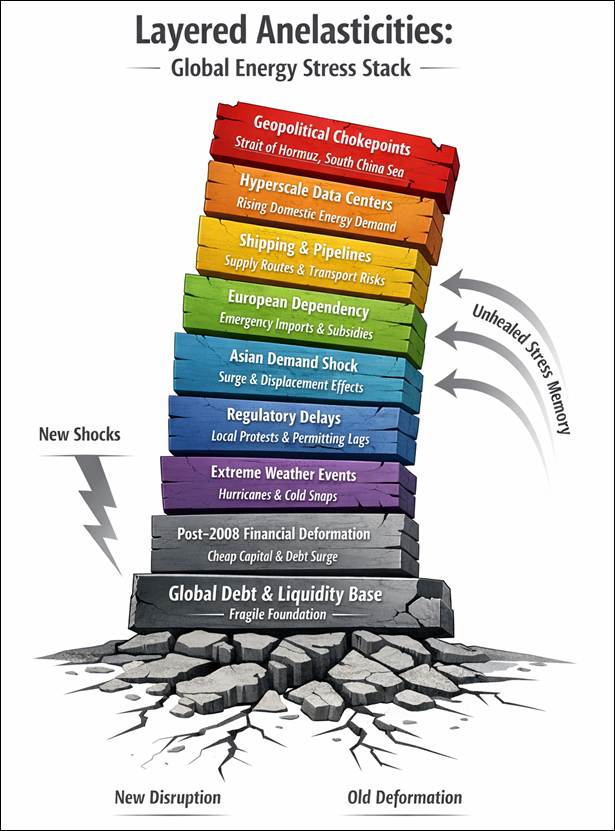
When woven together, these articles reveal a profound historical irony and a massive structural reorientation in how global energy and infrastructure are financed:
- The Carbon-centric finance model led to ESG and carbon markets funded via the anthropogenic narrative (Taxable/Regulated).
- The Resource realism finance model leads to capital pivots such as baseload security (Natural Gas, Grid Stability, AI Factories).