What brought US LNG and Russian gas prices together
In the past, pipeline gas was cheap because Russia had a strong position in Europe, while LNG was expensive because Europe had special pricing from Russia. Today, however, these have been overturned. LNG is plentiful, Europe now has enough infrastructure to accommodate it, Russia has lost its dominance of the market, and prices are determined by international competition. That is why the price difference is now only 2–4%, whereas in the past LNG was 20–40% more expensive.
In this context of trade war, Europe no longer buys Russian gas through pipelines, so Russia has lost the ability to impose low prices. Before 2022 it had a stable, tied market, which allowed it to sell cheaply through long-term contracts and meet almost 40% of European demand. After the interruption of imports, it was forced to turn to China, where pipelines are still limited, and to the LNG markets, where capacity is also small. Thus, it can no longer offer prices lower than LNG. At the same time, Norway has evolved into the true "lung" of Europe, providing stable and reliable quantities of gas, often more critical than US LNG imports.
The US is constantly expanding its production, Qatar is adding new large units, Australia has stabilized, and new projects in Africa, such as Mozambique and Mauritania, are entering the market. This oversupply is pushing LNG prices down and bringing them closer to pipeline gas prices. Of course, everything depends on the growth rates of Asia. The American LNG remains cheap because natural gas in the US is abundant today. Shale gas production keeps Henry Hub prices low, gas produced along with oil increases supply, and inventories remain high. This reduces the cost of LNG production and narrows the gap with pipeline gas. There is a new challenge: the growing demand for energy from data centers and artificial intelligence. By 2030, the electricity consumption of these infrastructures may reach current U.S. consumption levels, which will again put pressure on U.S. domestic demand for gas.
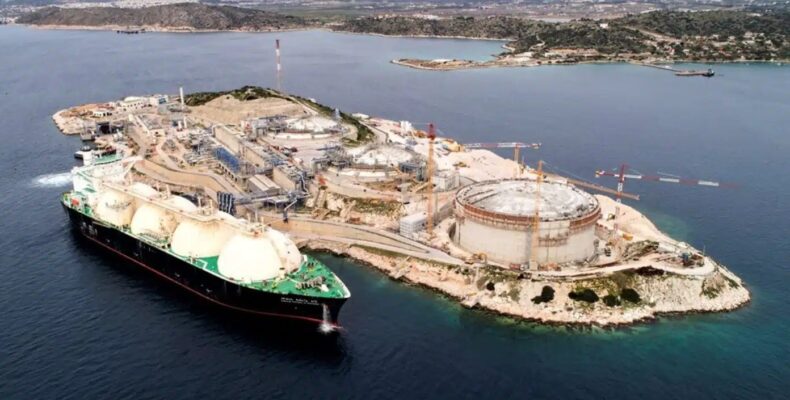
In 2022, Europe was paying excessively high prices because it did not have enough LNG gasification infrastructure. By 2024–2025, however, Germany installed five FSRUs, the Netherlands expanded Eemshaven, France increased capacity, Spain re-exported LNG, and Italy added new FSRUs, and Croatia has increased regasification capacity as has Greece. Thus, Europe no longer pays a "shortage premium" and American LNG reaches competitive prices. Competitiveness is enhanced by all three vertical South-North corridors, which allow the transport of gas from North Africa and South-Eastern Europe to Central and Eastern Europe, enhancing European energy security.
In summary, Russia used to price natural gas in order to keep Europe dependent, but also to ensure revenue. After the loss of the European market, it can no longer set prices and is forced to follow the market. Thus, the prices of pipeline gas are close to those of LNG, because Russia no longer has monopoly power.
Defense Point / ENERGY, Saturday 31, 2026
Αυτό έφερε κοντά τις τιμές ρωσικού αερίου, αμερικανικού LNG