ECONOMIC TRANSITION AND IMPACT ON THE ENERGY MIX
ECONOMIC TRANSITION AND IMPACT ON THE ENERGY MIX
Expanded English Edition – Eurasia Publications - ISBN: 978‑618‑5798‑74‑1
This new edition continues the analytical path initiated two years ago with Cause and Effect, where the central principle of my work was first established: the rule of cause and effect applied to global economic transitions. In that earlier edition, I introduced the concept that today’s systems no longer behave elastically but anelastically, since shocks leave permanent traces, partial recovery, and each disturbance becomes a new baseline. This foundational idea now serves as the structural backbone of the new book, guiding both the scientific input on the climate debate and the geopolitical analysis presented in the expanded edition.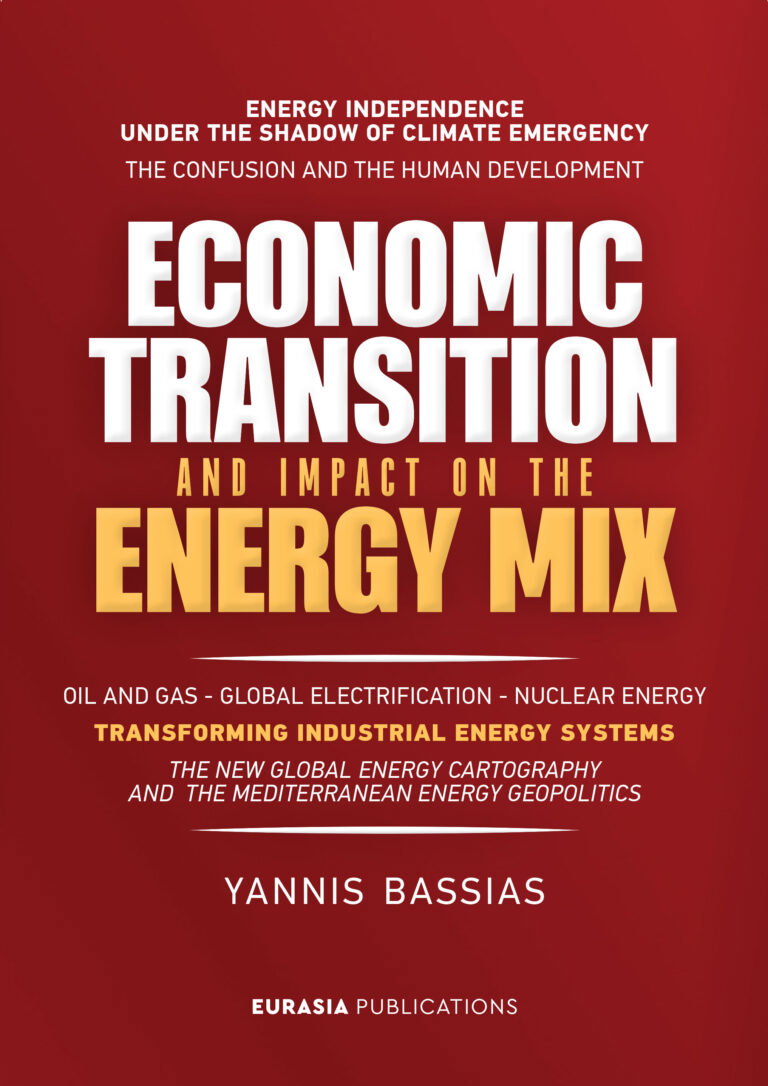
The book integrates the scientific material that has shaped the climate debate over the past decade, particularly the interaction between natural variability, anthropogenic forcing, and system response. It clarifies why climate systems cannot be simplified into linear models and why energy policy must be grounded in physics, density, and technological timelines.
It also develops the geopolitical framework established in recent years, examining the fragmentation of global markets, the emergence of regional blocs, and the strategic exposure of Europe and the Southeastern Mediterranean. The analysis shows how energy density, fuel diversity, and technological dependency shape geopolitical leverage across Eurasia and the Mediterranean.
This expanded edition is intended for policymakers, analysts, students, and readers seeking a factual, non‑ideological understanding of today’s energy transition, one grounded in scientific evidence, economic logic, and geopolitical reality.
Cause and Effect (Αίτιο και Αιτιατό), written in Greek in 2023 and released in April 2024, revisits a moment when the Western world was fully committed to the green transition. The European Union was increasing political pressure on fossil fuels and nuclear energy, limiting investments in oil and gas exploration, production, and infrastructure, and reducing support for baseload sources. It was a time when no major Western government had yet questioned this direction and well before the November 2024 presidential election in the United States prompted a broader reconsideration of energy and economic policy. The war in Ukraine then exposed the limits of the earlier approach.
Bassias argues in this book that the world was not experiencing an energy transition but a wider economic rebalancing driven by the pandemic, the war, and the rapid reshaping of global alliances, noting the growing influence of BRICS and the Global South, the strengthening of ties between Russia and China, and the gradual shift of economic gravity away from Western institutions. He highlights Europe’s rising dependence on imported gas and Chinese renewable technology and the long time required for new energy systems to mature. Drawing on his experience as president of Greece’s state company for oil and gas exploration and production from 2017 to 2020, he stresses the strategic importance of Greece’s own hydrocarbon reserves, which were set aside after 2020 despite their potential to reinforce national energy security. He sees both vulnerability and opportunity for Greece, noting that a practical and technology‑driven strategy could reposition the country as a regional energy hub.
The book calls for realism and long‑term planning, arguing that today’s turbulence reflects deeper economic forces than the green narrative suggests and warning that political messages often hide the structural pressures shaping global markets. For policymakers, analysts, and anyone following the energy debate, it offers a clear and data‑based counterpoint to optimistic expectations about rapid decarbonization, showing that many of the concerns now openly acknowledged were already identified in the book years earlier.
Available in hardcopy from Eurasia Editions in Athens and as a Kindle ebook.