Anelasticity Weekly Briefing 4- European Energy Systems - Week ending Saturday, 15 August 2026
Anelasticity Weekly Briefing 4 - European Energy Systems - Week ending Saturday, 15 August 2026
Layer | Key Week Parameters (Mon–Wed) | European Industry (EU–UK–Med–Nordics–CEE) |
Oil & Liquids | Mediterranean premia stabilize at high levels, but volatility increases as insurers apply new dynamic risk surcharges following yesterday’s drone incursions over Bulgaria and Germany. The overflights trigger temporary airspace restrictions across several Central European corridors, widening no‑fly zones and prompting precautionary shutdowns of multimodal logistics routes, including short halts in pipeline‑adjacent trucking lanes and selective inland‑depot closures. These disruptions ripple into crude and product scheduling, with operators reporting longer transit buffers and higher inland transport premia. Insurance markets tighten further as underwriters revise exposure models for Danube‑linked flows, Black Sea approaches, and long‑haul Med–CEE voyages. Refiners begin micro‑adjustments in crude slates, increasing reliance on short‑haul sour grades and reducing exposure to long‑haul sweet barrels from West Africa and the U.S. Gulf. North Sea operators extend minor maintenance outages, tightening prompt supply and reinforcing backwardation, while shipping firms adopt broader avoidance arcs around Baltic and Central European airspace, adding marginal transit time and bunker‑cost variability. Overall, the system enters a phase of heightened operational friction, where corridor disruptions, insurance tightening, and slate adjustments interact. | EU Med: Italy expands short‑haul procurement, adding incremental Algerian liftings and accelerating term negotiations with Libya. Greece increases pipeline‑fed crude intake and reduces exposure to Suez‑linked voyages. Spain shifts part of its procurement to pre‑agreed optional volumes to mitigate voyage uncertainty; refiners test heavier blends to stabilize feedstock timing. Germany: Inland transport protocols tighten further. Refiners introduce 48–72h scheduling buffers and reduce reliance on Rhine‑linked flows. Bulgaria (CEE): Black Sea corridor risk premia rise; operators widen inland detours and temporarily suspend night‑time product movements. UK: North Sea maintenance expands. Prompt supply tightens and traders extend backwardation and widen quality differentials. Nordics: Norway’s flows remain stable; shippers adopt broader avoidance arcs around Baltic airspace. Refiners maintain conservative crude slate composition. CEE: Import premia rise again. Refiners reduce discretionary runs and increase reliance on term barrels; elasticity remains minimal as corridor uncertainty persists. |
Gas & LNG | LNG corridor stiffness worsens as two carriers divert mid‑voyage, with Qatar–EU voyage times extending further and adding new variability to arrival sequencing. TTF shows a mid‑week upward correction driven by weather‑related demand, while storage refill slows due to heatwaves and industrial restarts, creating injection bottlenecks at several Central European hubs. Southern Europe faces fresh regas scheduling conflicts as operators compress berthing windows and shift maintenance to off‑peak hours. Cyprus’s imminent gas production introduces a new East Med supply node; early commissioning activity increases offshore traffic, triggers intermittent exclusion zones, and prompts preliminary routing simulations that begin reshaping medium‑term LNG balancing expectations across the Mediterranean. Oman–Iran discussions add uncertainty to Gulf export stability, while Saudi positioning on an “Islamic NATO” injects short‑term volatility into corridor‑risk premia. Additional carriers initiate pre‑emptive speed adjustments to hedge against Gulf‑route uncertainty, and several buyers extend tender validity periods to accommodate routing volatility. East Med terminals begin modelling dual‑node balancing scenarios incorporating Cyprus flows, while European traders widen forward‑curve spreads to reflect higher corridor‑risk convexity. | EU: TTF rebounds sharply; storage refill drops below 5‑year norms as injection constraints appear in Germany, Austria, and the Netherlands. Cyprus commissioning signals enter short‑term balancing models, adding operational friction and forcing recalibration of East Med routing assumptions. UK: NBP rises in parallel; LNG arrivals uneven with two diversions and one late‑week delay Terminals widen berthing windows and adjust boil‑off management. Med: Italy faces new regas queueing. Operators compress berthing slots and shift maintenance windows. Spain experiences congestion at both Atlantic and Med terminals; buyers extend tender validity to accommodate routing volatility. Cyprus’s new supply node forces early re‑mapping of regional LNG flows and prompts coordination discussions with Greece and Israel. Nordics: Pipeline flows remain stable; low LNG exposure shields volatility. Operators maintain conservative storage strategies. CEE: Corridor risk premia increase. Pipeline import scheduling tightens as Gulf and East Med uncertainties feed into long‑distance pricing. Hungary and Slovakia report higher balancing costs. Bulgaria increases buffer storage to offset inland transport risk. TSOs apply short‑term pressure‑management protocols to stabilize flows. Poland and Czechia model alternative scenarios for autumn procurement and adopt more conservative injection–withdrawal scenarios. |
Power Systems | Heatwaves persist; Germany’s north–south constraints worsen further, triggering record redispatch volumes. France faces additional nuclear derating as river temperatures exceed thresholds. Italy’s gas‑fired units face tighter fuel timing due to LNG congestion. Several flexibility pilots miss milestones. Cyprus–Greece interconnector discussions expand to include preliminary regulatory harmonization. | Germany: Curtailment reaches new highs; redispatch costs escalate. France: Additional nuclear derating; hydropower remains constrained. Italy: Peak premia widen further; gas‑fired scheduling tightens. Eastern Europe: Coal dispatch increases again; heat stress continues. Nordics: Hydropower stable; minor elasticity issues. UK: Battery project delays accumulate; peak premia rise. Cyprus–Greece: Interconnector talks broaden to regulatory alignment and early HVDC corridor mapping. |
Nuclear & SMRs | France’s ASN introduces new thermal‑stress documentation requirements. Poland and Czechia face fresh supplier delays as Asian shipments experience multi‑week Cape detours. UK nuclear output stable but one unit enters unscheduled minor maintenance. SMR consortia report additional design‑revision slippages due to component requalification needs. | France: Licensing cadence slows further; new thermal‑stress documentation required. Poland/Czechia: Supplier delays worsen; SMR timelines slip again. UK: Baseload stable; one unit enters short maintenance. Nordics: Finland & Sweden maintain slow SMR progress. Med: Italy focuses on grid reinforcement. Central Europe: Delivery schedules updated again. Engineering packages re‑sequenced to reflect longer shipping routes. |
Geopolitical Corridors | East Med diplomacy intensifies around Cyprus commissioning and Egypt–Israel coordination. Greece–Italy corridor receives new EU‑level attention. Balkan corridor planning accelerates after new feasibility funding. Cape detours expand as two major carriers declare permanent rerouting. Greece–Cyprus discussions broaden to include joint regulatory frameworks for electricity and gas corridors. | Greece–Bulgaria: Technical groups expand scope to include emergency routing protocols. Greece–Italy: EU‑level engagement increases; interconnector timelines reviewed again. Greece–Cyprus: Talks broaden to regulatory harmonization and joint corridor governance. East Med: Diplomatic activity rises around Cyprus commissioning. UK/EU: Cape detours expand; insurers revise models upward. CEE: Corridor premia remain elevated; planning bodies reassess long‑distance import exposure. |
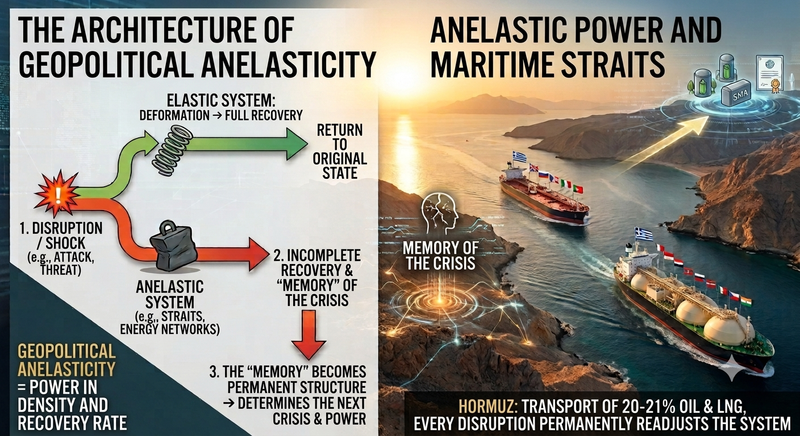
Market & Behavioral Response | Insurance premia rise again as Gulf risk models incorporate new drone‑pattern analysis. Utilities deepen defensive procurement; hedging horizons extend into Q1 2027. Traders reduce prompt exposure further. Corridor risk pricing intensifies across LNG and crude. Inland transport premia rise after new drone overflight. Regas terminals widen maintenance buffers. Anelasticity persists: procurement reactions remain slow to normalize. Hysteresis strengthens as operators maintain detours and elevated premia despite partial stabilization. | EU: Defensive procurement entrenched; long‑term contracts dominate. Inland premia integrated into refinery scheduling. Anelasticity: Elevated hedging persists despite partial flow normalization. Project impact: Flexibility tenders postponed again. TSO delays transformer delivery windows. UK: Corridor hedging increases; spot exposure reduced further. Hysteresis: Stricter berthing protocols remain. Med: Opportunistic buying absent; premia prohibitive. Anelasticity: Regas congestion prolongs scheduling caution. CEE: Discounts sought. Limited success. Bulgaria’s inland premia rise again. Hysteresis: Safety buffers widened further. Nordics: Stable procurement; conservative hydropower dispatch maintained. |