Block 2 as a Geopolitical Turning Point
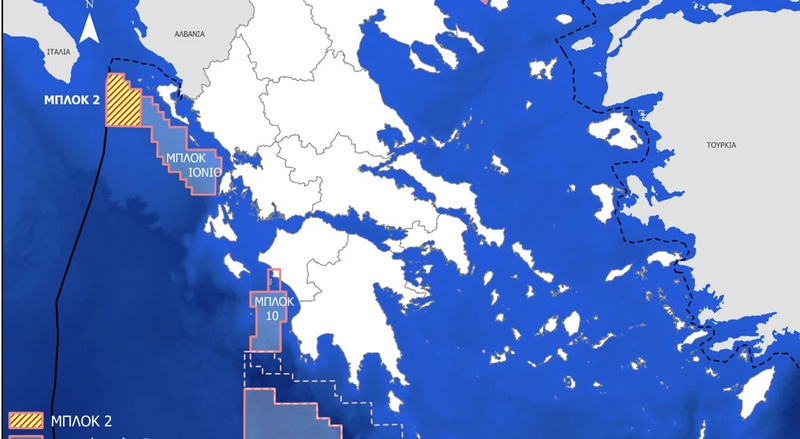
Block 2, north-west of Corfu, is currently the most advanced Greek offshore project, with full 3D seismic coverage and a mapped carbonate structure at a depth of approximately 4.6 kilometres. The probability of success in such deep limestone environments remains at 15–18 per cent, as is the case internationally in comparable high-potential systems.
Despite the inherent risk, Block 2 represents the first Greek venture capable of adding domestic upstream capacity to an energy system which, to date, has relied exclusively on midstream infrastructure. Although the international development cycle for deep-water fields typically ranges from 5 to 7 years from discovery to production, the latest Greek scenarios indicate that, provided there is an immediate final investment decision (FID) and fast-track infrastructure development, production could commence in as little as 3.5–4 years.
This short-cycle scenario is crucial because it enables Block 2 to be synchronised with the completion of the Greek energy hub, creating, for the first time in the country, a meaningful integration of generation and transmission networks (upstream–midstream), alongside the existing FSRUs, the IGB pipeline and the new interconnections with Italy.
The Regional Geopolitical Chessboard: East, South, West and Flows to Italy, Croatia and Greece
The need for the project to commence immediately becomes imperative when one considers the region’s geopolitical chessboard. In the eastern dimension, Azerbaijan’s natural gas exports to Europe stand at 11–12 bcm per year, whilst TAP is considering expanding its capacity to 20 bcm, thereby strengthening the Southern Corridor. Meanwhile, on the southern front, North Africa is emerging as a crucial supply pillar.
Algeria supplies Italy with approximately 21–23 bcm of natural gas per year via the TransMed pipeline, whilst also supplying Mediterranean refineries with hundreds of thousands of barrels of crude oil per day, as part of its total exports, which amount to 0.5–0.6 million barrels per day. Libya, via the Greenstream pipeline, supplies Italy with a further 2–3 bcm of gas annually, whilst producing approximately 1.1–1.2 million barrels of oil per day, exporting significant quantities of crude to Italy, Greece and Croatia.
At the same time, liquefied natural gas (LNG) is playing a catalytic role in shaping the new balance of power. Italy imports over 14–15 bcm of LNG annually via its terminals at Rovigo, Piombino and Panigaglia, whilst Croatia has become a key player in the Northern Adriatic through the Krk FSRU, with a regasification capacity of 2.9–3.1 bcm per year, supplying gas to Central Europe. For its part, Greece receives 2.5–3.5 bcm of LNG annually via Revythousa and the new Alexandroupoli FSRU. Within this polycentric market, where Italy is boosting its production in the Adriatic by exploiting carbonate formations that form the geological continuation into the Ionian Sea, and ENI is investing in deposits that are directly tectonically linked to Block 2, Greece is gaining the potential for a symmetrical upstream presence within a geologically unified zone, thereby ensuring a balance of power.
The European Energy Paradox and the Delays
At the same time, the necessary upgrade of European electricity transmission grids requires investment of 500–600 billion euros by 2040, facing delays of 8–12 years due to bureaucratic and environmental licensing procedures. As for green electrolysis, it remains an expensive technology, costing €3–6 per kg, with 1 GW of capacity producing just 140,000–175,000 tonnes of hydrogen per year, making its development on an industrial scale a matter of decades. In the meantime, natural gas is the only bridge fuel that can guarantee Europe’s energy stability.
All the evidence points to one inescapable reality: Block 2 must begin now. With a fast-track scenario involving discovery by 2027, an investment decision in 2028 and the start of production in 2031–2032, the project can be perfectly aligned with the peak in European demand for baseload power. For this reason, there is no room for further delays, regardless of political dynamics or bureaucratic obstacles.
Any politically motivated suspensions or delays would not merely constitute a postponement, but a serious strategic error that would deprive Greece of the opportunity to acquire upstream capacity at the very moment when the European market will need it. The window of opportunity is open today and represents an urgent national imperative.
Naftemporiki / Opinions, Tuesday, August 18, 2026
https://www.naftemporiki.gr/opinion/2151181/to-block-2-os-geopolitiko-simeio-kampis/