Europe’s New Gas Geography in the 2030s
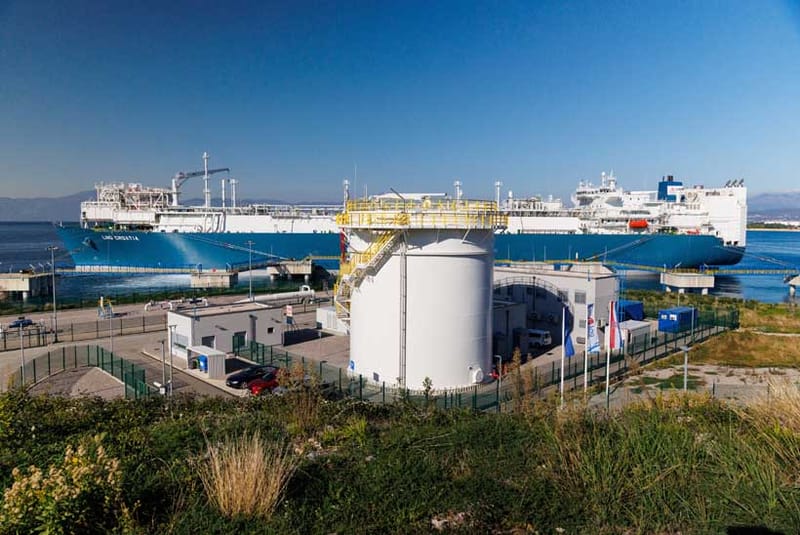
Europe enters the decisive years of its post‑Russian gas transition with a structural constraint that cannot be negotiated away. Political timelines move in short cycles while geological timelines do not. Deep‑basin non‑conventional gas in North Africa requires 5–7 years from licensing to commercial tie‑in and this temporal asymmetry shapes every initiative now underway. The Berlin–Algiers agreement of July 2026 illustrates this reality with clarity. It reallocates Algerian molecules through Italy’s SoutH2 corridor toward Germany, altering destinations but not volumes. Europe receives different gas, not more gas.
Across North Africa the bottlenecks are structural and persistent. Egypt has become a net importer. Zohr’s water‑related shut‑ins and rising domestic deficits force Cairo to rely on Israeli gas and floating regasification units. Algeria remains Europe’s most stable partner, but its exportable surplus is constrained by domestic electricity demand rising at roughly 4% annually. Subsidized power and desalination expansion intensify this pressure. Libya offers geological promise but political fragility. Greenstream’s physical capacity exists but its utilization depends on revenue‑sharing arrangements vulnerable to factional disputes. Morocco enters not as a producer but as a strategic transit actor anchoring a future Atlantic corridor linking West Africa to Europe.
Europe can cover one‑third of its Russian shortfall through North African volumes by 2027. The remainder will be bridged by American and Qatari LNG purchased at higher landed prices than pre‑2022 pipeline contracts. This introduces a structural diversification premium for European industry. Supply security increases and pricing advantage decreases. Diplomatic opacity reinforces this dynamic. By withholding volumes and pricing in the Sonatrach–VNG agreement, Berlin can claim a political win while obscuring the incremental scale of early deliveries.
The Balance of Risks
If Libya’s budget framework holds and Algeria’s domestic demand grows as projected, Europe secures a manageable though costlier supply mix. If political instability disrupts Libyan exports or Algerian winter demand forces Sonatrach to prioritize domestic heating, Europe could face a sharp supply shock precisely as the full Russian gas ban enters into force in late 2027. Conversely an accelerated Trans‑Sahara pipeline, early unconventional output from Chevron and Exxon, or more competitive Libyan licensing terms, could unlock a considerable North African surplus granting Brussels pricing leverage against Gulf and American LNG suppliers.
The Continental and the South-North Atlantic Corridors
The Trans‑Sahara Pipeline represents the most ambitious continental gas artery ever proposed in Africa. It is designed to transport 30 bcm/yr from Nigeria through Niger into Algeria’s export system. Its logic is straightforward. Nigeria holds the continent’s largest proven gas reserves. Algeria possesses the most mature export corridors into Europe. Niger provides the geographic bridge. Feasibility depends on synchronizing technical execution, commercial bankability, and political stability across regions marked by insurgency and coup‑related volatility.
The Trans‑Sahara corridor remains the continental anchor of Africa’s gas geography. Its logic is linear and its integration into Europe’s pipeline network is immediate once volumes reach Algeria’s export system. It offers the fastest route into Europe’s existing infrastructure and the most direct path for Nigeria’s upstream expansion.
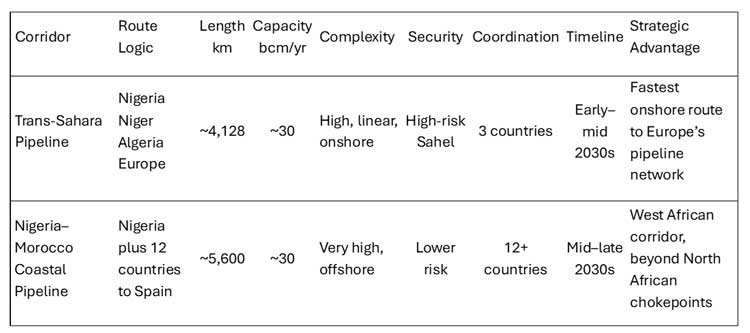
The Nigeria–Morocco Coastal Pipeline reflects a fundamentally different geopolitical logic. A 5,600‑kilometre Atlantic corridor linking more than a dozen West African states, bypassing the Sahel’s high‑risk interior while introducing major offshore engineering demands and complex multi‑state regulatory coordination. Its feasibility depends on sustained ECOWAS consolidation, harmonized tariff structures, sovereign guarantees, and environmental‑compliance frameworks. The indicative budget for these diplomatic and regulatory foundations is €1–1.5 billion. Engineering execution represents €20–30 billion. European integration through reverse‑flow upgrades and regasification expansion requires €3–5 billion. The total indicative budget falls between €24–36 billion.
Nigeria leverages the coexistence of both projects to maximize bargaining power, extracting concessions and financing commitments from Algeria and Morocco without committing decisively to either route. The decade ahead will be shaped by this rivalry. While the continental corridor depends on stability across a narrow but high-risk interior, the Atlantic corridor requires sustained regulatory harmonization across dozens of coastal states. Together, they define the two structural pathways for African gas in the 2030s.
Egypt and Tunisia, The Stabilizers
To complete the upside scenario Europe must incorporate Egypt and Tunisia into a broader stabilization framework. Egypt’s challenge is domestic balance rather than geology. Rising power demand, fertilizer production, and industrial consumption have outpaced gas supply. A fast‑track plan focuses on stabilizing domestic supply to prevent Egypt from competing with Europe for winter spot cargoes. Redevelopment of Zohr’s water‑management systems accompanied by incremental drilling in West Delta Deep Marine and modernization of LNG terminals are essential. The indicative budget is €5–8 billion over five years.
Tunisia’s role is subtle but critical. It hosts the TransMed pipeline (also called Enrico Mattei pipeline), the single most important corridor linking Algerian gas to Italy and Central Europe. Tunisia’s political and fiscal fragility represents a structural risk. A fast‑track plan focuses on securing transit continuity, modernizing pipeline integrity, and stabilizing the fiscal framework governing transit fees. The budget is modest, €1–2 billion over five years, yet its impact is disproportionately large.
Algeria, Libya, Egypt, Tunisia, Morocco, A Regional Architecture
When viewed together these axes form a coherent regional architecture where Algeria provides unconventional volumes, Libya fast‑cycle offshore growth, Egypt stabilizes the LNG environment, Tunisia secures the transit spine, and Morocco creates the Atlantic gateway. The budgets are substantial, between €54–81 billion over the decade. It is a realistic investment when distributed across national operators, international oil companies, sovereign funds, and European financial institutions.
Europe cannot fund upstream hydrocarbons under its climate taxonomy but it can finance midstream modernization, transit infrastructure, LNG terminal upgrades, digital monitoring systems, and regulatory harmonization. European companies can participate directly in upstream consortia in Algeria and Libya and indirectly in Egypt and Tunisia through engineering and midstream projects. Morocco’s NMGP is not an upstream project, allowing broader European participation in regulatory harmonization, environmental compliance, metering hubs, digital monitoring, and Spain–Morocco integration.
A Structural Pillar for Europe’s Energy Future
By uniting these regional anchors into a single strategic framework, North Africa can transition from a constellation of constrained suppliers into a unified exporter capable of generating a true surplus. The upside scenario becomes feasible only if Europe accepts that it must participate financially and politically in regional stabilization even if it does not directly fund upstream hydrocarbons. North African gas must be treated not as a temporary bridge but as a structural pillar of Europe’s energy architecture for the next decade. The required €54–81 billion capital deployment represents the definitive investment needed to secure European energy independence and regain critical pricing power against global LNG suppliers through the 2030s.
Modern Diplomacy / Energy Geopolitics, Monday, August 3, 2026
https://moderndiplomacy.eu/2026/08/03/europes-new-gas-geography-in-the-2030s/