ExxonMobil and Chevron as the ‘stabilising force’ in developments involving Turkey and Libya
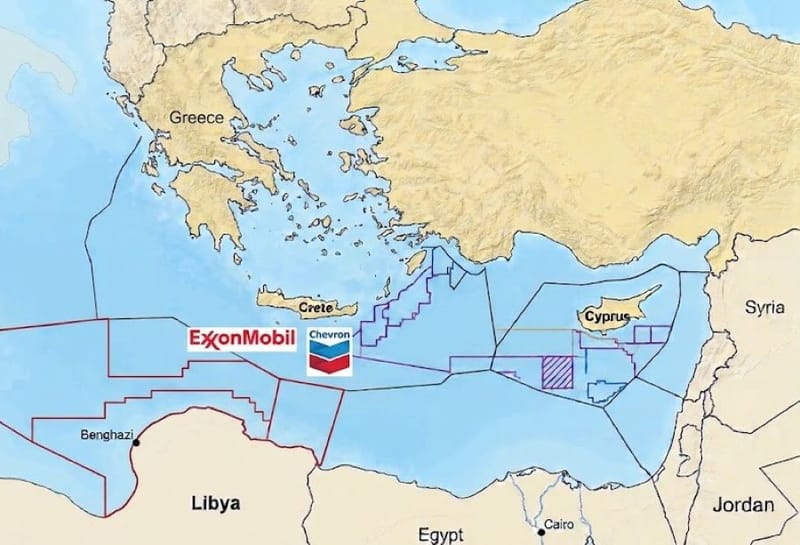
The Libyan National Oil Corporation (NOC) is implementing a $40 billion investment programme aimed at increasing production to 2 million barrels per day. The NC 146 deep-water block is also at the centre of offshore exploration activities. This area is directly affected by Turkey’s efforts to consolidate its presence, the issue of the median line, the geological affinity with the basin south of Crete, and the stance taken by Greek consortia.
The NC 146 deep-water offshore block
NC 146 is an unexplored deep-water offshore block in the Libyan maritime zone of the Mediterranean. The recent signing of a Memorandum of Understanding (MoU) between NOC and Chevron for the technical evaluation of NC 146 confirms the US decision to reinvest in the region. Meanwhile, ExxonMobil is conducting preliminary technical studies on four offshore blocks in Libya’s north-western maritime zone and in the Gulf of Sirte, whilst actively participating in the new licensing rounds.
Chevron’s decision to undertake the evaluation of NC 146 is of particular geological interest, as the company is also active under exploration licences south of Crete. Both the Eastern Mediterranean basin south of Crete and the deep waters off Libya are characterised by similar carbonate structures (carbonate shoals/reefs) and ancient marine basins. This is the geological model in which natural gas is trapped in shoals and carbonate rocks, whilst there are also indications of oil.
In both areas, the potential deposits lie beneath great depths of sea and thick layers of sediment. The expertise Chevron will gain from the NC 146 survey on the Libyan side provides valuable comparative data on the geological continuity of the reservoirs towards the Cretan side, confirming that the wider maritime basin between Greece and Libya offers similar prospects for major discoveries.
The return of US companies comes at a time when Ankara is systematically attempting to impose its own agenda on Libya. Through the illegal 2019 Turkish-Libyan memorandum of understanding, Turkey is attempting to usurp maritime zones in the Eastern Mediterranean. Although the Turkish state-owned TPAO has concluded bilateral agreements with the Tripoli government, no major Western company (such as Chevron, ExxonMobil, Eni or TotalEnergies) has so far agreed to enter into a joint venture with TPAO within Libya.
Western companies are choosing to sign contracts directly with Libya’s NOC, thereby avoiding legitimising Turkey’s claims. Furthermore, both Chevron’s NC 146 and ExxonMobil’s four offshore blocks are located well outside the arbitrary Turkish-Libyan zone.
TPAO’s lack of the necessary deep-water expertise, combined with the legal annulment of bilateral Turkish agreements by Libyan courts, has forced Tripoli to turn once again to US companies, which deliberately choose areas free from geopolitical disputes.
The current situation in Libyan waters acts as a catalyst for stability, with a direct impact on the equidistance line between Greece and Libya. US companies avoid becoming involved in disputed or arbitrarily demarcated zones, which effectively enforces the rules of the United Nations Convention on the Law of the Sea (UNCLOS).
The simultaneous presence of these companies on both sides of the median line (Crete and Libya) reinforces institutional and scientific continuity, thereby undermining Turkish claims regarding the disappearance of the Greek continental shelf.
Against this complex backdrop, the question arises as to why Greek hydrocarbon companies are not operating directly in Libya. This stance is the result of a deliberate strategic choice.
Firstly, the geopolitical and legal risk in Libya remains extremely high due to the country’s political division and the uncertainty surrounding agreements. A Greek company would risk becoming entangled in political and diplomatic pitfalls.
Secondly, deep-water offshore drilling requires enormous capital and high insurance costs, which only global companies can absorb.
Consequently, Greek companies prefer the ‘farm-in’ strategy, acting as partners alongside US conglomerates within the Greek EEZ (south of Crete and in the Ionian Sea), leaving the management of Libya’s geopolitical risks to the major players.
In Libya’s overall investment plan, 70 per cent to 80 per cent of available funds are earmarked for the oil sector to boost daily production from onshore basins, such as Chevron’s onshore Block Area 106 in the Sirte Basin. In contrast, in the natural gas sector, funding is focused on deep-water offshore structures, such as NC 146.
However, NC 146 should not be regarded solely as a gas field but also as an oil field, both to meet domestic electricity generation needs and to supply future export pipelines to Europe.
Activity in the region should restore the region’s energy prospects within the framework of international law, respect for the median line and secure international alliances.
Defence Point / Greece-Cyprus, Saturday, October 24, 2026