From the demolitions in Ptolemaida to the data centres with imported gas: The Greek energy paradox
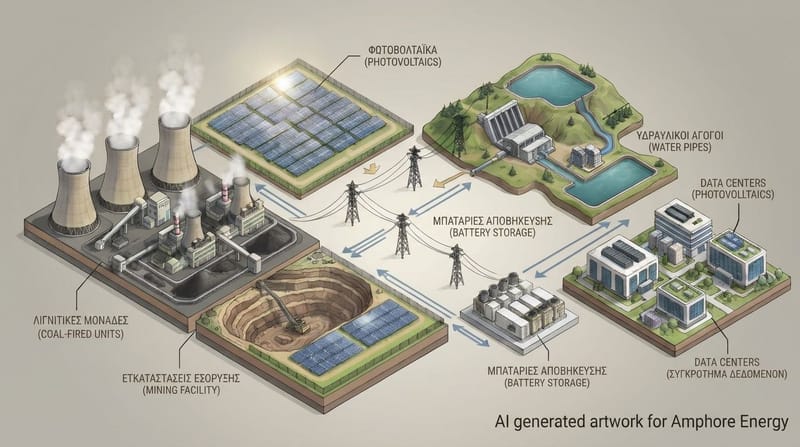
Whilst industrial Europe, led by Germany – as Bloomberg aptly analyses – is realistically returning to the flexible use of coal and the maintenance of its thermal power stations to shield itself against price fluctuations, the Greek government is dismantling its own lignite-fired power stations through urgent procedures and celebrating this ‘achievement’ in Ptolemaida.
Such a contradiction is not merely a matter of public relations. It comes at a high cost and, above all, is starkly reflected in the energy market’s profitability indicators, the so-called Spark and Dark Spreads. When international prices for natural gas (TTF) and emissions allowances push production costs upwards, solid-fuel power stations become economically competitive and act as a buffer against extreme wholesale prices. Germany is keeping this safety net in place.
In contrast, Greece has opted for a drastic, unilateral phase-out of lignite, leaving the system exposed to imported natural gas and intermittent renewables without adequate storage, on the grounds that the ongoing installation of solar panels and wind turbines is sufficient for a country with ‘low energy needs’.
Technically speaking, it must be acknowledged that Greek lignite has a lower calorific value (1,200–2,000 kcal/kg) compared with the combination of imported hard coal (hard coal) and domestic German lignite (lignite / Braunkohle) (5,500–6,500 kcal/kg and 1,900–2,700 kcal/kg respectively). However, this limitation pales into insignificance in the face of the Greek paradox. Greece mines lignite, exports it to Skopje where it is burnt in thermal power stations, and then imports the electricity generated, paying foreign additional costs and grid losses. Furthermore, the debate often blurs the lines between the Public Power Corporation (PPC) and the Ministry of Environment and Energy.
The truth is institutionally clear: the PPC does not operate in a vacuum. The Ministry of Environment and Energy is the sole body responsible for formulating national energy policy; the body that legislated for early decommissioning, approved the environmental permits and provided the political backing for the demolitions, transforming a complex technical and economic equation into an ideological dogma.
Things become even more problematic when one considers the ambitious plans for ‘post-lignite’ Western Macedonia, which promise to transform the region into a hub for large data centres – such as the converted Ptolemaida V power station – to be powered by natural gas, pumped-storage and battery facilities. The figures reveal the true scale of the economic burden.
A data centre complex with an installed capacity of 300 MW (with a realistic average utilisation factor of 90 per cent, i.e. a continuous load of 270 MW) requires an uninterrupted base load 24 hours a day, 365 days a year, consuming approximately 2.37 TWh annually, i.e. 4.5% to 5% of the country’s total annual electricity consumption. With a typical efficiency factor of 58% for a modern combined-cycle natural gas power station, 4.08 TWh of thermal fuel energy is required. With average natural gas prices of 35–40 €/MWh, the country will be forced to pay an additional 143 to 163 million euros each year in foreign exchange solely for the purchase of imported gas, replacing a domestic resource with zero foreign exchange cost with one that is 100 per cent imported.
As for the argument that the gap in the stable supply of renewable energy will be filled by pumped-storage hydroelectricity, such as the proposed project at the former Amyntaio mine, the very laws of physics disprove it. A pumped-storage project in the range of 300–320 MW with a 6-hour storage cycle has a total capacity of approximately 1.8 to 1.92 GWh (approximately 2 GWh). If called upon to supply the aforementioned 270 MW data centre complex, the Amyntaio reservoir would be completely drained in just 7 hours, leaving the servers without power for the remaining 17 hours of the day. Furthermore, pumped-storage does not generate energy. It operates with cycle losses of 20–25 per cent (requiring 2.5 GWh to return 2.0 GWh) and relies on there being a surplus of cheap renewable energy to pump the water up. On still, overcast winter days in Western Macedonia, the pumps either remain switched off or end up pumping water by burning imported natural gas once again, increasing the cost by a quarter, quite apart from the serious geotechnical constraints posed by the eroded soils of Amyntaio. In other words, the whole narrative of an uninterrupted supply is based on wishful thinking: it requires the simultaneous convergence of consistently favourable weather conditions, storage capacity on a scale many times greater than at present, and perpetually low prices for imported natural gas – an equation that, in the realpolitik of energy, never adds up.
To celebrate the dismantling of your own baseload power stations, whilst selling lignite to your neighbours only to buy back expensive electricity from them, and planning energy-intensive digital parks powered by imported gas, this does not constitute an energy transition, but a strategic dead end. The true cost of this policy of self-deception is paid daily by Greek households and the productive economy through their electricity bills, as they watch a country single-handedly undermine its own energy stability.
The article is accessible on: Naftemporiki / Opinions, Sunday, November 15, 2026
Amphore Energy image is AI generated