Hard truths in the new energy landscape! (podcast)
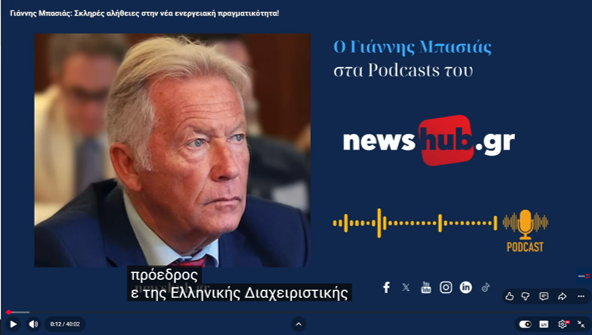
The interview gave the opportunity to revisit the hard truths shaping today’s energy reality, moving beyond slogans and political comfort to the deeper structural forces at work.
For two to three decades, renewables were promoted as a clean replacement for oil, gas, coal, and hydroelectric baseload sources. Conventional fuels had the advantage of being available whenever needed and easily stored, a fact often overlooked in public debate. The latter had the advantage that they can be used whenever we need them, while they can also be stored. Renewables, by contrast, were presented as a magical solution that could replace baseload generation even when weather conditions were unfavorable, a narrative that was embraced enthusiastically by consumers without understanding the future cost implications.
An entire economic and social ecosystem was built around the exclusive blame placed on carbon dioxide for global warming. Europe invested more than 1.2 trillion euros in this transition, creating a powerful institutional momentum that shaped public expectations and political choices. Within this climate of optimism, perceptions of national security were also affected. A psychology of prosperity took hold across European societies, fostering the belief that past threats were theoretical or exaggerated.
This complacency became visible when geopolitical shocks intensified. Faced with rapid global changes, Europeans began searching for security guarantees in Turkey, often overlooking the contradictions between their declared principles and their diplomatic behavior.
Turning to Greece, the discussion offered a direct assessment of hydrocarbon exploration efforts. In Crete, as explained, the absence of infrastructure and technical continuity has prevented the development of a stable operational framework. ExxonMobil’s departure reflected years of insufficient institutional support, prompting the company to redirect its focus to the Ionian Sea, an extension of the Adriatic and already an established energy corridor for southern Europe. South of Crete, Chevron is attempting to balance the complex dynamics between Greece and Libya, though current findings remain preliminary. If commercially viable deposits are confirmed, Greece could secure thirty to thirty five percent of the produced energy value, a significant benefit for national interests.
The discussion expanded to the global energy system. It was warned that the consequences for international security architecture are severe and likely to remain so. The world must secure sufficient energy volumes for the coming decades. The United States will require far more natural gas than it currently produces, given that 90% of its output is consumed domestically. Massive data centers and computational hubs demand extraordinary amounts of energy, adding pressure to an already strained system.
Throughout the interview, we returned to a central theme: the energy transition is unfolding within a geopolitical environment far more volatile than many anticipated. Europe’s choices, the fragility of supply chains, and the shifting balance of power in regions such as North Africa will shape the next chapter of global energy strategy.
The message is steady and unembellished. The new energy reality is not defined by easy solutions or comforting narratives. It demands technical seriousness, geopolitical awareness, and a willingness to confront difficult truths.
Newshub.gr / Podcast, Tuesday, July 28, 2026