How petrol prices are set: They rise instantly, but fall like a feather
Setting fuel prices is not a simple matter, nor does it change at the flick of a switch every time the international price of oil fluctuates. Behind the figures lies a whole mechanism involving taxes, stock market fluctuations and the physical journey the fuel takes before it reaches the fuel tank.
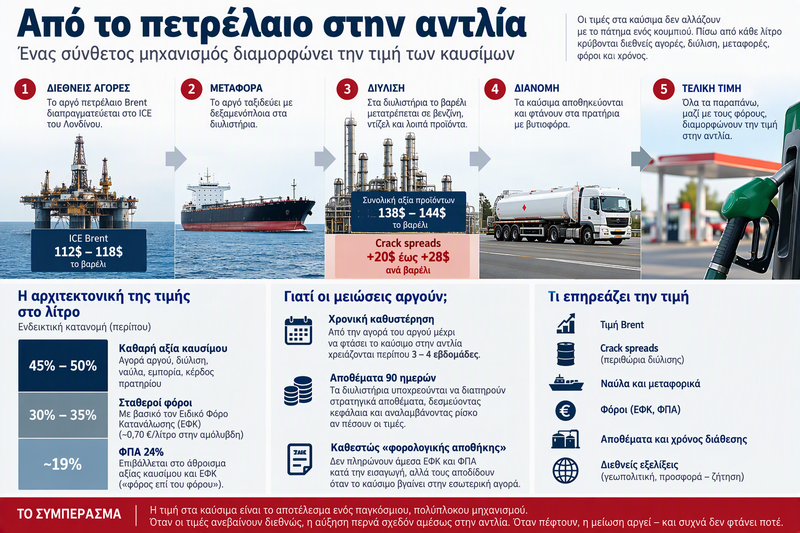
When Brent crude and refining margins (known as ‘crack spreads’) rise on international derivatives markets, such as the London Stock Exchange (ICE), the increases are passed on almost immediately at the pump, justified on the grounds of ‘replacement cost’. This mechanism is based on two simultaneous pricing factors:
Crude oil (ICE Brent), which is traded on the exchange at a range of $112 to $118 per barrel.
The total yield of the products (crack spreads). When the refinery takes this barrel and converts it into petrol, diesel and other derivatives, the total value of the output rises to between $138 and $144 per barrel.
This extra $20 to $28 per barrel is the ‘spread’ that inflates the initial price of the fuel before the products even leave the refinery.
However, when oil prices fall or crack spreads narrow, the reduction in production is typically slow to materialise – or may never happen at all – if new international turmoil arises in the meantime. The market argues that it must first sell off the expensive stock it purchased earlier. This is yet another illustration of the economic and energy pressures the world has been facing in recent years.
The Price Structure at the Pump
To understand what we are paying when we fill up, we simply need to break down the price per litre into three components:
The net value of the fuel (45 per cent to 50 per cent). This includes the cost of crude oil, the refinery’s profit, the freight costs of tankers, as well as the profits of trading companies and petrol station operators.
Fixed taxes (30% to 35%). The main component is the Excise Duty (EFK), which is a fixed amount per litre (around 0.70 euros for unleaded petrol) and does not change whether oil costs 50 dollars or 116.
The 24 per cent VAT: This is levied on the sum of the fuel’s value and the Excise Duty. In practice, this amounts to a double tax (‘tax on tax’): the more the initial price of the fuel rises, the more the VAT in euros automatically increases, accounting for almost one-fifth (approximately 19 per cent) of the total price we pay at the pump.
Time lag – The refinery context
This is where consumers’ main complaint arises: why do prices remain high when oil prices fall?
Greek refineries purchase crude oil during periods of crisis at the day’s highest prices. It takes around three to four weeks from the moment the oil is loaded until it is refined, stored and delivered by tanker to petrol stations. So, even if Brent or London-traded derivatives fall today, the pump will remain ‘stuck’ for at least a month, because that is when the cargo purchased at a high price becomes available on the market. And if, during that time, there happens to be a new rise in international prices, the previous fall simply disappears.
At the same time, refineries operate within a specific framework of obligations and incentives:
90-Day Stockpiles: The law requires them to maintain strategic safety stockpiles for 90 days, which ties up huge amounts of capital and creates a risk if prices fall sharply.
‘Tax Warehouse’ Scheme: The state allows them to defer payment of excise duty and VAT upon importation, paying these only when the fuel enters the domestic market.
In periods of high inflation, the state resorts to certain checks on profit margins or to one-off levies; however, none of these measures address the root cause: the structural burden on the consumer.
Naftemporiki / Opinions, Sunday, October 25, 2026