The Architecture of Geopolitical Inflexibility
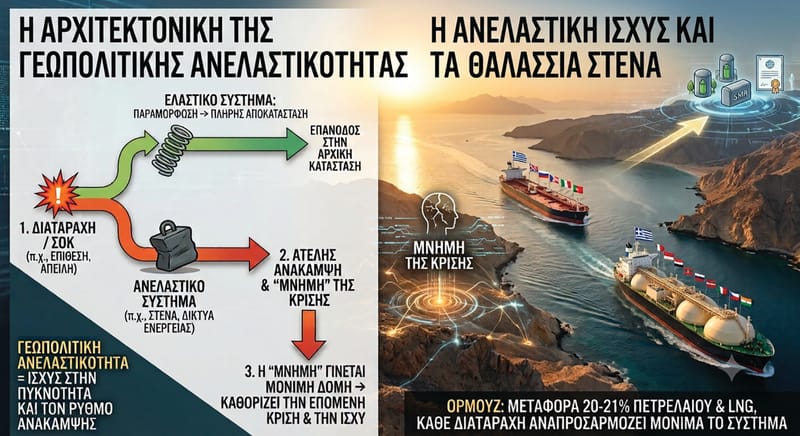
To understand inflexibility as a geopolitical principle, it is worth considering the following pillars:
Physical inelasticity: An inelastic material under pressure deforms and recovers only part of its original shape. The remaining deformation persists as a permanent ‘memory’ of the shock.
Economic inelasticity: A good is inelastic when demand for it does not decrease significantly even if its price rises, as the need is so pressing that the system cannot adapt quickly.
Supply and infrastructure constraints: In global flows, the physical capacity of bottlenecks is fixed and unchanging.
Today, these concepts converge in geopolitical rigidity: the property of critical infrastructure to deform under pressure, to recover imperfectly and to retain a permanent memory of shocks. In a world where flows are concentrated at a handful of key nodes, power shifts from extent to density. What matters is not who controls the space, but who controls the rate of recovery and the management of friction.
Maritime Corridors and Strategic Straits
The Strait of Hormuz
It is the most characteristic example of inelastic infrastructure, accounting for over 20–21 per cent of global oil consumption and approximately 20 per cent of global LNG. The events of July 2026 and the tensions of 2027 confirmed this: the IRGC’s attacks on merchant ships, the avoidance of the US-protected corridor by major companies and the rise in insurance premiums sent Brent prices soaring to over 90–94 dollars. The system did not revert to normal, but was permanently adjusted. Hormuz does not correct; it remembers.
Bab el-Mandeb, Suez and the SUMED Pipeline
Bab el-Mandeb (the ‘throat’ of the Red Sea) handles 8–10 per cent of seaborne oil flows and 12 per cent of global trade. The Houthi attacks have shown that a strait does not need to be closed to trigger a crisis; the threat alone is enough. The threat drives up insurance premiums, forces ships to sail round Africa and brings the crisis to Europe. Any diversion via the Cape of Good Hope increases transit time, fuel costs and pressure on capital, leaving a lasting mark on the Europe–Asia corridor.
The Mozambique Channel: An Alternative Route, but Not a ‘Painless’ One
When the Red Sea becomes unstable, shipping flows to the Mediterranean and Western Europe shift further south, increasing traffic through the Mozambique Channel by 50–80 per cent. However, geopolitical inflexibility is confirmed here too: there are no absolutely safe, ‘flexible’ alternatives. The Mozambique Channel introduces its own structural vulnerabilities, such as local piracy, instability in Cabo Delgado and exposure to extreme weather events. The diversion does not eliminate the risk, but transforms it into new forms of operational cost.
The Greek Merchant Fleet as a Global Stabiliser
Within this strictly inelastic system, the Greek-owned merchant fleet – the world’s largest in terms of tankers and LNG carriers – acts as the key mechanism for operational flexibility. The adaptability, readiness and geographical dispersion of the Greek fleet allow for the immediate re-routing of cargoes when maritime chokepoints are ‘locked’. However, Greek shipping does not eliminate the system’s inflexibility; it acts as a pressure relief valve that absorbs natural fluctuations in volume, whilst the system absorbs the increased financial costs (insurance premiums, fuel, delays) . It thus becomes a critical piece of infrastructure for global supply security.
European Energy Inelasticity and the Digital Boom
Europe remains structurally inelastic because it imports 68–70 per cent of the primary energy it consumes, whilst the domestic 30–32 per cent (nuclear, renewables, hydroelectric power) is unable to absorb external shocks. This energy fragility is exacerbated by the digital boom: demand for electricity from data centres and artificial intelligence applications is growing exponentially, whilst the supply from the grids is expanding only linearly.
With countries such as Ireland and the Netherlands already approaching ‘digital saturation’ and France now treating electricity as a strictly strategic infrastructure, European digital growth is hitting a wall without new base-load capacity.
This creates a direct chain of dependency: the exponential demand for AI and data centres necessitates increased imports of LNG and fuels, with the result that any disruption in the Strait of Hormuz or the Red Sea is instantly translated into industrial costs, inflationary pressure and a strategic impasse for the European economy.
The Adriatic Axis and Greece’s role in the east
The Adriatic hub now constitutes the new energy backbone of South-Eastern Europe. It is a system of infrastructure and interconnections that integrates the natural gas markets of Central Europe with the Mediterranean, creating a single area of flows, flexibility and security of supply.
Greece is an integral part of this new architecture through a network of infrastructure projects that now operate in a complementary manner and strengthen its regional role: Revythousa, the Alexandroupoli FSRU, which adds new capacity, increases the flexibility of flows and strengthens the ability to supply the Balkan markets, and the interconnections with Bulgaria and Italy. At the same time, to the east, a vertical corridor is emerging towards South-Eastern Europe, the Eastern Mediterranean and the Balkans. This corridor strengthens Greece’s strategic position, as it can act as a natural bridge for new LNG imports, regional infrastructure and European markets seeking diversification.
Prospects for Greece’s Entry into the SMR Ecosystem
Greece does not need to become a manufacturer of Small Modular Reactors (SMRs) to assume a strategic role. It can become a provider of technology, services and infrastructure by collaborating with leading countries in the sector (the US, France, Canada, South Korea, Japan), focusing on four pillars: certification and licensing, digital platforms and monitoring, technical training, and industrial support.
Inelasticity as the Permanent Global Norm by 2030
By 2030, inelasticity will no longer be a temporary disruption, but the permanent operating norm of the global system. Europe, continuing to import 68–70 per cent of its energy, will operate in an environment where any crisis will translate directly into industrial costs. The need for stable baseload power (such as nuclear energy) will now be a technical necessity for powering data centres and artificial intelligence.
In this context, power will not necessarily lie with the countries with the largest geographical area, but with those that have the capacity to absorb shocks and provide stabilisation technologies to their partners. Greece, by capitalising on its geographical position at key maritime chokepoints and developing LNG infrastructure, interconnections and specialised technology/certification services (SMR), could evolve by 2030 into a key regional pillar of stability.
In the world that is taking shape, maritime straits, energy networks and digital infrastructure function as systems that ‘remember’ every shock. Europe will continue to operate in an environment of structural fragility. Greece, situated at the point where global flows converge, has the opportunity to turn the memory of crises into a strategic advantage, offering security and technological stability in an inflexible world.
Kontra News/ Opinions, Sunday, August 3, 2026
https://www.kontranews.gr/apopseis/i-architektoniki-tis-geopolitikis-anelastikotitas/