What the Great Sea Interconnector Really Means
In Cyprus, public debate has been far quieter, centered on cost recovery and electricity bills rather than offshore surveys—even though Cyprus is the main beneficiary as the only EU state still cut off from the European power grid.
Reducing the GSI to another Greek-Turkish flashpoint misses its real purpose: it is a European infrastructure project tied to energy security, maritime rights, industrial policy, and regional influence. Conceived between 2011 and 2013 after the Tamar, Leviathan, and Aphrodite gas finds to link Israel, Cyprus, and Greece, the cable has evolved over the past decade from a technical link into a strategic asset amid rising concerns over supply security and critical infrastructure protection.
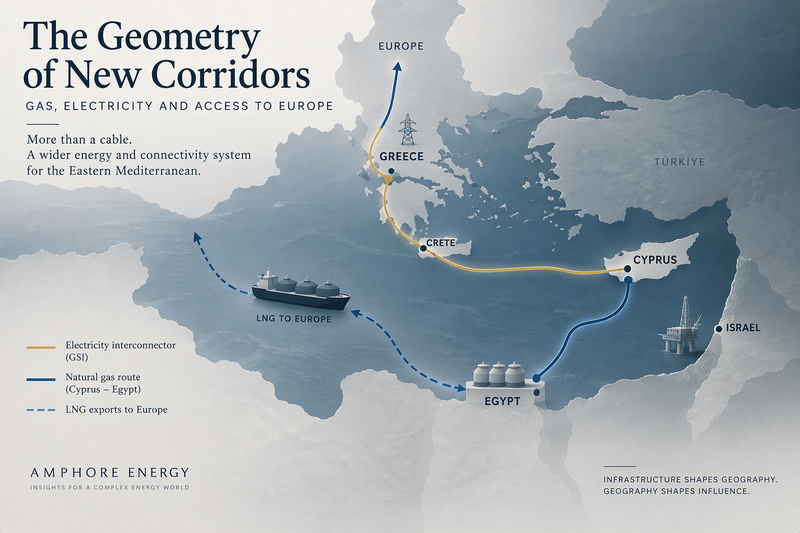
In the Eastern Mediterranean, influence now rests less on naval power or gas discoveries alone than on connectivity—high-voltage cables, LNG terminals, pipelines, ports, and subsea fiber optics. Moving and balancing energy carries as much weight as producing it, creating cross-border ties that outlast political cycles.
This logic aligns with the growing energy partnership between Cyprus, Egypt, and European majors. Following the 2026 Final Investment Decision and engineering deals for Cyprus’s Block 6, Eni and TotalEnergies are building a direct supply chain to Europe: gas from fields like Kronos flows via Egypt’s Zohr network to the Damietta LNG plant, before shipping to European terminals like Revythousa and Alexandroupoli.
Yet gas exports alone cannot solve Cyprus’s isolated, expensive power grid, which still relies on imported liquid fuels and faces renewable curtailments. The GSI completes the picture: while the LNG route monetizes gas, the subsea cable integrates Cyprus into Europe’s electricity market, bringing two-way flows, grid stability, and lower long-term prices.
Together, the gas corridor and power link form a dual regional framework—Cyprus as producer and hub, Egypt as liquefaction center, and Greece as the EU’s southeastern gateway for molecules and electrons. Turkey’s opposition stems from this reality: a European-backed corridor bypasses it and shifts the regional balance.
France’s role through cable maker Nexans, fund Meridiam, and steady diplomatic backing gives the project clear European weight. Prolonged delays now test the EU’s credibility and strategic autonomy in a region where local powers and Gulf investors are already entrenched.
Beyond routine NAVTEX alerts and short-term maneuvering, the stakes are clear: Greece cements its gateway status, Cyprus ends its grid isolation, France secures a geopolitical foothold, and the EU seizes a rare chance to shape the Eastern Mediterranean’s infrastructure map.
Energia.Gr/ Article, Monday, November 16, 2026