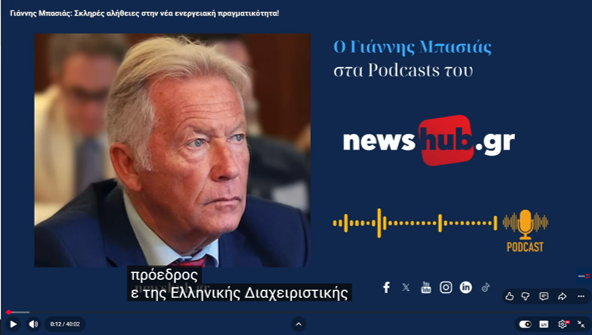
Why energy inelasticity is the obstacle to falling energy prices! What Greece must do! (podcast)
Europe has entered an era characterised by a simultaneous accumulation of crises, economic downturns and demographic pressures, and this is where decision-makers should be focusing their attention.
Each crisis builds on the previous ones and prevents the system from returning to its original equilibrium! Take, for example, the EU’s energy dependence: 58 per cent of its energy comes from imports! No matter how full the natural gas storage facilities are, they do not guarantee cheaper bills.
The second ‘memory’ is the depreciation of major investments: when you invest in something, you have to write it off! This can take many years, especially if the investment is substantial. We currently need to finance new investments, but at the same time we must repay and write off previous ones, so all of this creates a series of problems
This brings us to the third issue, which is the labour shortage caused by an ageing population. By 2050, there will be two people in work for every pensioner! The issue of storage is a case in point, because we’ve reached the point where we’re debating whether it’s worth investing in it or not!
‘The EU has been resting on its laurels for three decades: on the one hand, Russia with its natural gas and cheap energy, and on the other, the US with its bases protecting Europe; so now that it has lost both, it has its back against the wall!’
Energy, defence and Artificial Intelligence are three huge issues because they now require equally huge investments. Where will Europe find the money for all this? It will be forced to make constant cuts to the ‘welfare state’
Energy prices are not going to fall! And this is because the energy inelasticity we described does not allow them to fall! Before one issue is resolved, another comes along and piles on top of it, blocking any progress.
What can Greece do? We can hope that the first drilling will take place in 2028 in the Ionian Sea. There is a strong likelihood that it will be successful and that Greek companies will participate in the vertical corridor! The second step is to convince the US that the EU is not willing to invest in the Vertical Corridor’s infrastructure, but rather in the modernisation of the networks. It will therefore be important for the US to invest in the Vertical Corridor.
Newshub.gr / Podcast, Tuesday, October 7, 2026