Newsletter 21 September, 2026 -Reading the Summer
Energy & Geopolitics Newsletter - September 2026 - Reading the Summer
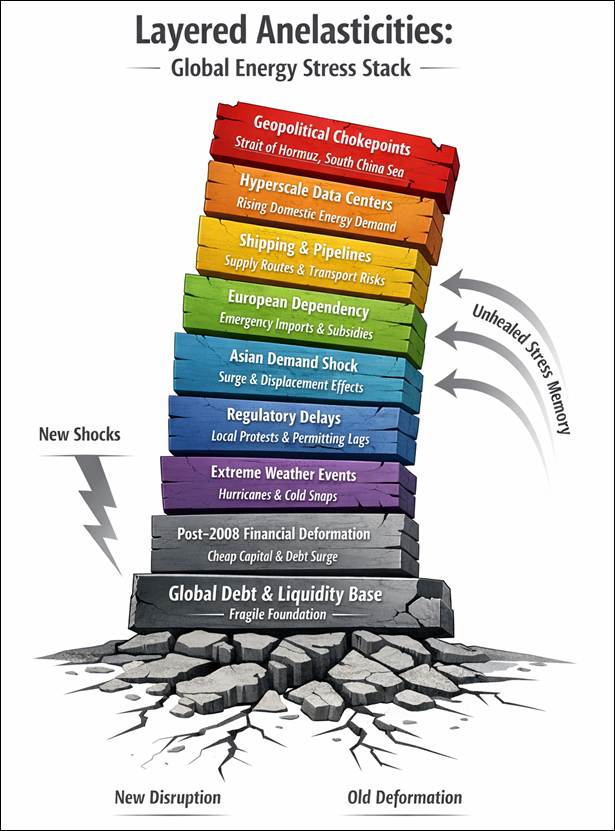
The articles published over recent weeks, from mid-July, may appear to address different subjects, from European policy failures and maritime chokepoints to gas corridors, fuel pricing, public debate and energy education. Yet together they describe a single reality: the global energy system has entered a phase of persistent anelasticity, where shocks no longer dissipate but accumulate, overlaying one another and permanently reshaping markets, infrastructures and political decisions.
The starting point lies in Europe's long strategic drift following the end of the Cold War. Believing that geopolitical competition had largely disappeared, much of Europe progressively reduced its focus on energy security, strategic reserves, infrastructure redundancy and domestic resource development. Financial optimization increasingly replaced physical resilience. The Ukraine war brutally exposed the fragility of this approach, demonstrating that prosperity built upon uninterrupted energy flows can rapidly become vulnerable when geopolitical realities return. What appeared for decades as efficiency now reveals itself as a loss of strategic margin.
This awakening is directly connected to another recurring theme: the world's maritime corridors have become a structural memory of crises. The Strait of Hormuz, Bab-el-Mandeb, the Suez Canal and the Red Sea are no longer isolated chokepoints temporarily disturbed by geopolitical incidents. Each crisis leaves behind higher insurance premiums, rerouted shipping patterns, longer transportation times and lasting risk perceptions. The Gulf tensions, attacks on commercial vessels, disruptions in the Red Sea and the continuing activities of the Houthis demonstrate that the system never truly returns to its previous condition. Every disturbance leaves a scar, reinforcing the idea that modern energy corridors behave like anelastic structures that absorb shocks imperfectly and retain
https://www.naftemporiki.gr/opinion/2140839/ta-thalassia-stena-os-domiki-mnimi-ton-kriseon/
The instability created by the Ukraine conflict has therefore not been replaced by Middle Eastern tensions. The two crises have merged into a broader environment of cumulative insecurity. The Gulf remains exposed to military risks, maritime transport continues to face disruptions, and the Houthis have added another layer of uncertainty to already stretched trade routes. Rather than witnessing a sequence of independent crises, we are observing the formation of a permanent risk structure where multiple geopolitical theatres interact simultaneously. Energy markets increasingly price this accumulated uncertainty rather than reacting to single events.
Against this backdrop emerges Europe's new gas geography for the 2030s. The continent is progressively redefining supply routes around LNG imports, North African producers, Mediterranean corridors and alternative transit systems. Yet the underlying message is that replacing Russian molecules does not automatically create security. New corridors require investment, political stability, infrastructure development and long-term commitments. Geography has re-entered energy policy. Distances, maritime routes, interconnections and physical bottlenecks matter again. Europe is discovering that diversification is not merely a commercial concept but a strategic architecture. https://moderndiplomacy.eu/2026/08/03/europes-new-gas-geography-in-the-2030s/
Within this broader reconfiguration of European energy corridors, the development of Greece's Block 2 offshore area emerged as a particularly important geopolitical signal. More than a conventional exploration project, Block 2 illustrates the gradual return of physical resource security to the center of European strategic thinking. Located north-west of Corfu and supported by extensive 3D seismic data, it represents one of the most mature upstream opportunities currently available in Greece. At a time when Europe is searching for diversified gas supply routes and reduced external dependencies, the project underlines a larger reality: domestic resources, even when they cannot transform continental balances alone, contribute to resilience, bargaining power and strategic optionality. The significance of Block 2 therefore extends beyond geology. It reflects the re-emergence of exploration as an instrument of energy security in a continent that for many years concentrated on markets while neglecting the foundations of supply.
https://www.naftemporiki.gr/opinion/2151181/to-block-2-os-geopolitiko-simeio-kampis/
Alongside these analyses, Amphore Energy launches the Anelasticity Briefing for European Energy Systems, a new bi-weekly publication designed to monitor the progressive accumulation of structural stresses across the continent's energy architecture. Rather than focusing exclusively on price movements or isolated events, the briefing follows the interaction between LNG corridors, electricity grids, nuclear developments, storage levels, maritime disruptions, geopolitical tensions and regulatory decisions. Its objective is to identify where temporary disturbances are becoming permanent structural constraints and where resilience gaps continue to widen. The initiative reflects the conviction that Europe has entered an era in which energy systems no longer return rapidly to equilibrium after crises. Instead, they absorb, retain and accumulate the effects of successive shocks, creating the anelastic behaviour that increasingly characterizes the continent's energy future.
Several articles also sought to clarify misunderstandings surrounding fuel prices and energy economics. Public discussion often treats Brent as if it were the direct retail price of fuel. In reality, Brent represents only one element within a much longer chain that includes refining margins, transportation costs, inventories, distribution systems, taxation structures and geopolitical risk premiums. The resulting retail price reflects the complexity of an integrated industrial system rather than the simple movement of a benchmark barrel. Understanding this distinction becomes increasingly important in periods of high volatility when consumers seek straightforward explanations for complex phenomena. https://www.naftemporiki.gr/opinion/2146498/to-brent-kai-i-aplopoiisi-tis-pragmatikis-alysidas-timologisis-kaysimon/
The same educational effort extends to the broader public debate on energy. Electricity systems are frequently portrayed as simple marketplaces where renewable generation automatically reduces costs. The reality is more complex. Modern power systems must continuously balance generation, storage, transmission, flexibility and reliability. The value of a kilowatt-hour depends not only on its production cost but also on its availability at the precise moment it is needed. As renewable penetration increases, flexibility, reserve capacity and grid investments become central economic variables. Energy education therefore becomes a strategic necessity rather than an academic exercise, because affordable, secure and continuously available energy is no longer something societies can assume.
https://www.naftemporiki.gr/opinion/2152587/energeiaki-paideia-kai-dimosios-dialogos/
These individual discussions ultimately converge in the framework developed in Beyond Slogans: The Ten Structural Realities Governing Modern Energy Systems. The article argues that contemporary energy systems are governed by enduring constraints rather than political aspirations. Security of supply, energy density, infrastructure inertia, technological dependencies, geopolitical exposure, capital intensity and physical geography continue to shape outcomes despite evolving narratives. The transition is occurring, but it is unfolding within structural limits that cannot be legislated away. Technology may evolve rapidly, yet infrastructure evolves slowly; markets react quickly, yet energy systems remain bound by decades-long investment cycles.
https://moderndiplomacy.eu/2026/09/02/10-realities-shaping-global-energy/
The recent interview surrounding Economic Transition and Implications for the Energy Mix brings many of these themes together. The book argues that energy transitions cannot be understood solely through environmental objectives. They must also be analyzed through the lenses of economic growth, energy density, technological dependence, security requirements and geopolitical exposure. The central conclusion is that future energy systems will not be defined by a single dominant source but by the ability of nations to combine diverse energy forms while maintaining resilience in an increasingly uncertain world. The transition is therefore less a linear march toward a predetermined destination than a continuous adjustment between economic necessity, technological capability and geopolitical reality.
https://www.defence-point.gr/synenteyxi-oikonomiki-metavasi-amp-epiptoseis-sto-energeiako-meigma
Taken together, these analyses point toward the same conclusion. The age of assumed stability has ended. Europe, the Middle East and global maritime networks now operate in a world where shocks accumulate faster than systems can absorb them. Energy security, corridor resilience, infrastructure realism and public understanding are becoming as important as decarbonization targets themselves. In this emerging environment, the concept of energy anelasticity provides not merely a description of market behavior but a framework for understanding the strategic transformation of the global energy order. Economic Transition and Impact on the Energy Mix - AMPHORE ENERGY